

6 Signs of an Emotionally Empty Marriage
You can share a bed, a mortgage, and a last name with someone and still feel completely alone.
That gap has a name. Therapists call it emotional neglect, and it is one of the quietest forms of relationship pain because nothing dramatic ever seems to happen.
There is no big fight. No betrayal. Just a slow fading of closeness until two people who once knew everything about each other start to feel like strangers who share a house.
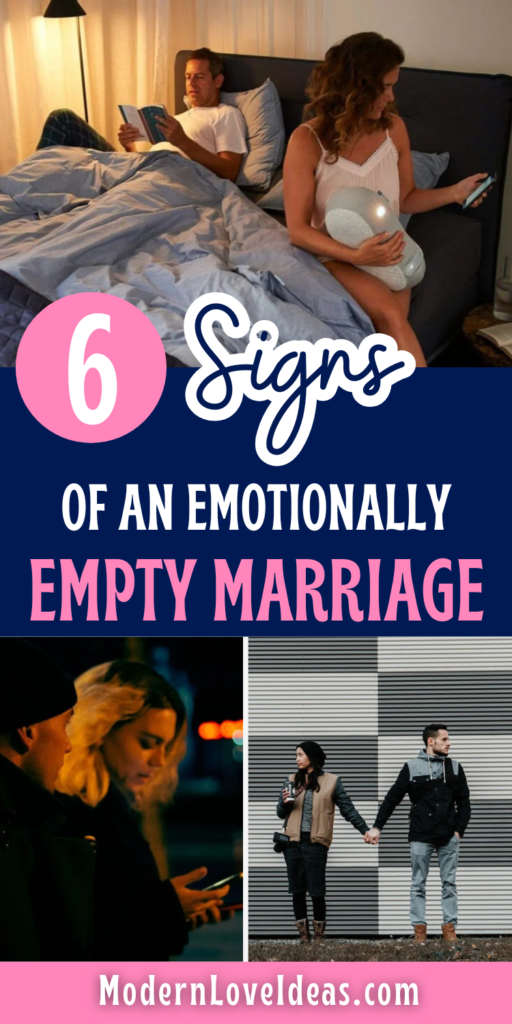
A graphic on relationship emptiness recently outlined six signs of this pattern, and current research backs up every one of them. Here is what each sign actually looks like, and why it matters.
1. Roommate Syndrome
If your conversations mostly cover groceries, schedules, and who is picking up the kids, you are not imagining the distance.
Clinicians who study emotional neglect in marriage describe this as one of the clearest warning signs. Couples stop asking about each other’s inner life and instead talk only in logistics, and over time one or both partners start to feel lonelier inside the marriage than they would alone.
This matters because logistics keep a household running, but they do not build closeness. A marriage needs both.
2. Phone Barrier

Reaching for your phone during a quiet, slightly tense moment with your spouse feels harmless. Research suggests it adds up to something bigger.
Researchers who study this pattern, known as technoference, found that partners spend roughly 27 percent of their time together on their phones, and almost everyone admits to using a phone at least some of the time while sitting with a spouse.
The same study found that phone use specifically around a partner, not total daily phone use, predicted lower relationship satisfaction.
The phone itself is not the problem. The habit of choosing it over a hard conversation is.
3. Relief in Absence
One of the most telling signs of an empty marriage is quiet relief when your spouse leaves the house.
This is not the same as enjoying time to yourself. It is a sense that the air in the house feels lighter without them in it. Writers tracking what some are calling a modern loneliness epidemic inside marriage point to a 2025 AARP survey finding that 42 percent of married men reported feeling lonely, often because they had quietly stopped sharing their day with their spouse and started keeping it to themselves instead.
If peace only shows up when your partner is gone, that is worth paying attention to.
4. The Silent Wall

Sharing a bed with someone you feel emotionally cut off from is one of the loneliest experiences a person can describe.
This is closely tied to a pattern researchers call stonewalling, where one partner withdraws and stops engaging during conflict or connection.
Decades of research from the Gottman Institute found that stonewalling predicts divorce with roughly 93 percent accuracy when it becomes a couple’s default pattern.
Physical closeness without emotional closeness is its own kind of distance. The body is present. The connection is not.
5. Apathy Replaces Anger
It might sound like good news when the arguments stop. Often it is the opposite.
Relationship researchers note that the absence of conflict can signal something more serious than peace. According to Gottman’s research, contempt and emotional checkout, the sense that a couple’s emotional reserve of goodwill has become deeply overdrawn, often shows up right before couples stop fighting altogether, simply because neither partner believes there is anything left worth fighting for.
Caring enough to argue is, strangely, a sign that something is still alive between two people. Its absence is the real red flag.
6. Public Perfection

You smile for the photo. You play the part of the happy couple at dinner with friends. Then you go home and barely speak.
This gap between the public version of a marriage and the private reality is more common than most couples admit. A review of hidden marital struggles found that couples frequently describe their marriage as perfect when asked directly, even while unresolved distance and unhappiness sit just beneath the surface, largely because social pressure makes admitting trouble feel like personal failure.
Performing closeness in public does not heal the lack of it in private. It usually just delays the conversation both partners need to have.
What These Signs Actually Mean
None of these six signs on their own means a marriage is over. Every long relationship moves through dry seasons.
What matters is whether these patterns are occasional or constant. A couple who occasionally talks more about logistics than feelings, or who has one quiet week, is different from a couple where this has become the only mode they know.
If several of these signs feel familiar and have lasted for months rather than weeks, that is usually a sign the relationship needs outside support, not just more effort behind closed doors. A licensed couples therapist can help identify whether the distance is repairable and what repair would actually require.
Emotional distance rarely announces itself with a single moment. It builds quietly, one skipped conversation at a time. The good news is that the same small moments that created the distance can also be used to close it, once both partners are willing to look at what is actually happening between them.