
Why Romantic Gestures Matter More Than Gifts in a Relationship
The bracelet was beautiful. You said thank you. You wore it to dinner. And about four days later, you felt the same quiet loneliness you felt the week before he gave it to you.
You have probably never said that out loud. Because how do you explain it? He remembered. He spent real money. He picked something nice. Saying it did not land makes you sound ungrateful, or picky, or like one of those women who is impossible to please.
You are none of those things. And the gap you are feeling is real.
The question underneath all of this is not really about romantic gestures vs gifts. It is about whether the person who lives in your house actually sees you. A gift can prove that. Most of the time it does not.
Here is what research says about what makes someone feel loved, why price and thoughtfulness are two different things, and a list of small romantic gestures you can start using this week. There is also a script at the end for saying all of this to your partner without it turning into an argument.

What Counts as a Romantic Gesture, and What Doesn’t
A gift is a thing. A gesture is proof that someone was paying attention.
Here is a quick test. Could a stranger holding your Amazon wish list have done this? If yes, it is a purchase. If no, it is a gesture.
The necklace from the mall passes as a gift and fails as a gesture. The coffee he made before you woke up, in the mug you like, is the opposite. It cost him almost nothing and it proves he knows something specific about you.
This is not an argument for being cheap. A gesture can cost money. Booking the hotel near the lake you mentioned once in March is a gesture, and it is expensive. Meanwhile, a shrug and a gift card can cost fifty dollars and prove nothing at all.
The line is not price. The line is evidence of noticing.
Most partners who get this wrong are not being lazy on purpose. They think they are being romantic. They have been told for their whole lives that love shows up wrapped. So if attention is what actually counts, why does everyone keep reaching for their wallet instead?
Why Spending More Doesn’t Make You Feel More Loved
Researchers have tested this directly, and the results are not subtle.
Across three studies, gift givers assumed that the more they spent, the more the gift would be appreciated. They believed an expensive gift sends a message about how much thought went into it. The people receiving the gifts reported no such link. Price did not predict how appreciated they felt. This held up for engagement rings, birthday gifts, and controlled experiments.
So there is a real gap here. He thinks the number on the receipt is doing emotional work. It is not.
And the number keeps climbing. Americans spent a record 29.1 billion dollars on Valentine’s Day in 2026, with shoppers budgeting an average of 199.78 dollars each. That is up from 188.81 dollars the year before. An entire industry is telling your partner a story every February, and the research does not back it up.
None of this makes him thoughtless. It makes him miscalibrated. He is following instructions that were wrong.
What Actually Makes People Feel Loved, According to Research
When researchers asked hundreds of people what makes them feel loved, the answers were not what a jewelry ad would predict.
Penn State researchers surveyed 495 American adults and found people mostly agree on this. Small, non-romantic gestures topped the list. Someone showing compassion. Someone being kind without being asked. Nothing expensive, nothing planned, nothing that required a reservation.
The bottom of the list is worth noticing too. Controlling behavior, like a partner wanting to know where you are at all times, ranked as the least loving thing on the list. Some people confuse checking up with caring. The people receiving it do not.
Zita Oravecz, one of the researchers behind this work, has said that love is usually not grand gestures. More often, people experience it as smaller and more regular acts.
That is why the bracelet did not fix anything. A bracelet is one moment. Feeling loved is a rate.
The 86 Percent Rule Behind Relationships That Last
There is a piece of research that explains almost everything about this, and most people have never heard it.
Relationship researcher John Gottman studied couples for decades. He watched them do ordinary things and tracked something he called bids for connection. A bid is any small attempt to reach for your partner. It can be a comment about the weather. A hand on your shoulder. Holding up a phone to show you a photo. Saying “look at that bird.”
You can respond three ways. You can turn toward it and engage, even a little. You can turn away and miss it. Or you can turn against it and snap.
Gottman followed newlywed couples and checked back six years later. Couples who were still married had turned toward each other 86 percent of the time. Couples who had divorced had done it only 33 percent of the time.
Read that again, because it is doing a lot of work. The thing that separated the couples who made it from the couples who did not was how they handled tiny, boring, forgettable moments.
Here is the part that matters most. The bird was never the point. When someone says “look at that bird,” they are asking a different question. They are asking, are you there. The bird is just the excuse.
A gift is one bid, once a year. Your partner makes dozens of them a week. So does he.
Why This Hurts Women More Than Men
If you have felt like you are the only one keeping score on this, you are not making it up.
A YouGov survey of more than a thousand adults found men were far more likely than women to say they feel listened to in their relationship. Seventy-nine percent of men said they always or usually feel listened to. For women, it was 65 percent.
The same survey found women were more likely than men to say they at least sometimes feel frustrated in their relationship, 63 percent to 46 percent. On feeling resentful, it was 33 percent to 22 percent. Women were also about three times as likely as men to say a partner had disappointed them by not doing enough on Valentine’s Day.
So there is a gap, and it runs in one direction.
But be careful what you do with that. This is not evidence that men do not care. It is evidence that a lot of men do not know. He is not sitting there deciding to withhold attention. He genuinely believes the gift covered it, because nobody ever told him otherwise.
Which raises the obvious question. If he does not know, how would he find out?
Why Love Languages Won’t Fix This
Almost every article like this one tells you to find his love language. Here is why this one will not.
A 2024 review of the research on love languages found little support for its main claims. The researchers, led by Emily Impett, looked at the studies that exist and found three problems. People tend to value all five expressions of love, not one. The five categories overlap so much that it is unclear they are separate things. And matching your partner’s stated language does not reliably predict a happier relationship.
Impett has pointed out the quiz itself is part of the trouble. It forces you to pick between things like receiving gifts and holding hands. In real life, nobody makes you choose.
The researchers offered a better comparison. Love is not a language you translate. It is closer to a balanced diet. You need several kinds of nourishment, not one.
Here is why this matters for you specifically. “Receiving gifts is his love language” gets used as an explanation when it is really an excuse. Sometimes buying something is not a love language. Sometimes it is just the easiest option available at 9pm the night before.
8 Small Romantic Gestures You Can Do on an Ordinary Tuesday

None of these take an hour or a reservation. Most take under a minute. They work in both directions, so read them as things you can do and things you can ask for.
Answer the bird
When he shows you something small, respond like it counts. Look up. Say something back. It does not have to be interesting. The response is the entire point.
Text the specific thing, not the generic thing
“Thinking of you” is wallpaper. “I hope the 2 o’clock with Dave goes better than last time” is proof. The second one takes the same ten seconds and does something completely different.
Handle the thing she was dreading
Call the insurance company. Deal with the return that has been sitting by the door. Cancel the appointment she keeps forgetting to cancel. Taking one item off someone’s mental list is more intimate than most dinners out.
Put the phone face down
Not in your pocket. On the table, screen down, where she can see you did it. Looking at a screen while someone is still talking is turning away with better lighting.
Bring back the thing she likes
The specific chips. The wrong-flavor seltzer she likes anyway. The candy bar from the gas station. The item costs two dollars. The message is that you keep a list of her in your head.
Say the appreciation out loud, with the detail attached
“You’re great” bounces off. Try this instead. “You handled bedtime tonight when you were completely fried, and I noticed.” Specific praise lands because it proves you were watching.
Ask a second question
Anyone can ask how your day was. The second question is where it stops being a formality and starts being a conversation. “How did that end up going?” costs nothing.
Kiss for six seconds
Long enough to be a moment. Short enough for a Tuesday. Most couples default to the two-second exit kiss and forget there is another option.
If reading that list made you think he should already know all of this, hold onto that feeling. There is a way to say it.
When a Gift Is Actually the Right Call
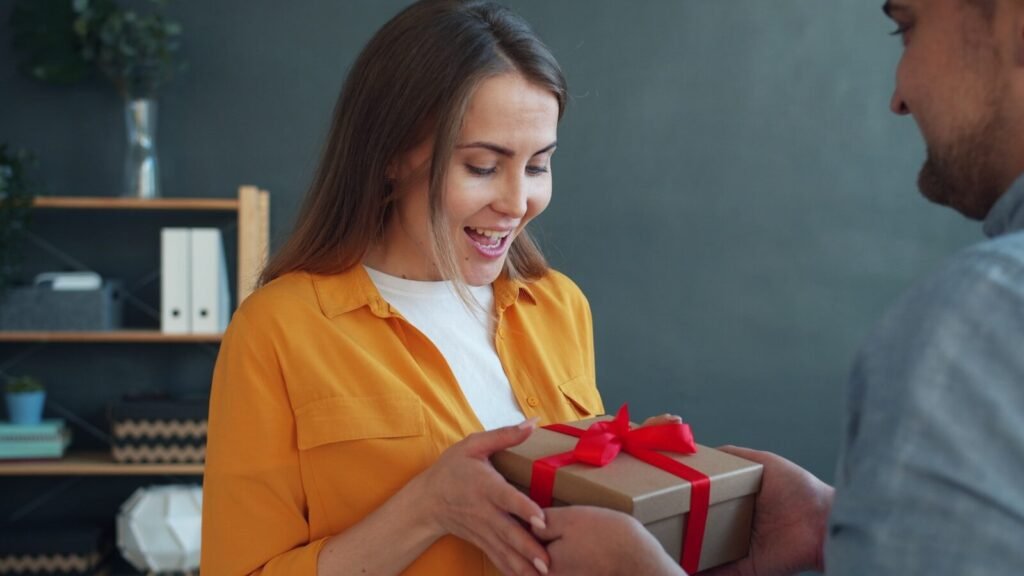
None of this means gifts are bad. That would be a silly thing to argue, and it would also be wrong.
Gifts land beautifully when they prove attention. The problem is only when a gift gets used as a replacement for attention.
There is also good news for anyone who feels weird about asking for what they want. Gift recipients were more appreciative of gifts they specifically asked for than gifts they did not, across five studies. Givers assumed both would go over equally well. They were wrong. Even better, recipients rated the requested gifts as more personal and more thoughtful, which is the exact opposite of what most of us assume.
So the wish list is not unromantic. Sending him a link is not cheating. He is more likely to guess wrong than you are to ruin the surprise.
Experiences tend to beat objects too. Cornell researcher Thomas Gilovich has spent years showing that experiences produce longer lasting satisfaction than things, partly because you do not sit around comparing a weekend away to somebody else’s weekend away.
Real people say the same thing when asked. In a January 2026 survey of more than 2,400 adults, 48 percent said quality time at home was their preferred Valentine’s Day gift, and 43 percent said they would rather have an experience than a physical present.
Here is the rule that covers all of it. A gift that proves he noticed is a gesture. A gift that proves he remembered the date is a receipt.
How to Ask for What You Need Without Starting a Fight
The reason most women never say any of this out loud is that asking for romance seems to cancel out the romance. If you have to request it, does it still count?
Yes. That is what the research on requested gifts shows. Asking does not make it less thoughtful. It makes it more likely to actually work.
Do not lead with the complaint. Lead with an example of something that already landed. Try something like this:
“The other morning you made my coffee before I was even up, and I thought about it for the rest of the day. That does more for me than anything you could buy me.”
That sentence does three things at once. It gives him a win. It shows him exactly what the target looks like. And it never once implies he has been failing.
If you are coming off a disappointment instead of a good moment, use a different opening:
“I know you got me something nice and I know you meant it. What I miss is the small stuff during the week. Can we do more of that?”
Ask for frequency, not for a specific act. If you ask for flowers and then get flowers, it feels hollow to both of you. If you ask to be noticed more often, he gets room to come up with his own ideas, and his ideas will mean more than your instructions.
One last thing, so you are not blindsided. He will overcorrect for about two weeks and then drift back. This happens to almost everyone. It is not proof that he does not care. Reminding him again is not nagging, it is maintenance, and every relationship needs some.
Start With One Small Thing Tonight
The bracelet was never the problem. The problem is that a bracelet is an event, and being loved is a rhythm.
The research on romantic gestures vs gifts keeps landing in the same place. Price and appreciation are not connected. Small gestures beat grand ones. And what makes someone feel loved is whether the person across from them turns toward them when it would be easier not to.
So pick one thing off that list and do it tonight. Do not announce it. Do not wait to see if he does one back. Just answer the bird once and see how the room feels.
Then tell me in the comments. What is the smallest thing your partner does that makes you feel the most loved?