

Perimenopause Libido: Real Fixes Backed by Science
You used to want it. Then somewhere in your forties, the wanting just stopped showing up.
Maybe it happened slowly. Maybe one day you noticed your husband had stopped reaching for you because he was tired of hearing no. Either way, you are now lying awake at night wondering if something is wrong with you, wrong with your marriage, or if this is just what happens to women your age.
Here is what almost nobody tells you. Changes to your perimenopause libido are one of the most common symptoms of this stage of life. They are also one of the least talked about and the least treated.
This article covers what is actually happening in your body, why the timing is not a coincidence, and what you can do about it. You will learn which of your symptoms have real treatments, which popular options are a waste of money, and exactly how to bring this up with a doctor so you are not brushed off.
None of this means your sex life is over. It means you finally have information most women never get.

Why Your Sex Drive Changed at 45 and Not Before
Perimenopause is not a slow slide down. It is more like a hormone roller coaster that lasts for years.
Your estrogen does not just drop. It spikes and crashes without warning, sometimes within the same month. Your cycle gets shorter, then longer, then skips entirely. All of that happens before your periods stop for good.
And your desire tracks it closely.
Researchers followed 3,302 women aged 42 to 52 across seven American cities in a study called SWAN. They found that the odds of vaginal or pelvic pain went up and desire went down by late perimenopause, even after they accounted for age, health, and stress. That last part matters. This was not simply getting older. It tracked the transition itself.
The timing is even more specific than that. The same research group found that the drop in sexual function is sharpest around 20 months before your final period and up to a year after it. So if your last period was two years ago, you may have already passed through the hardest stretch without knowing it.
None of this means you stopped caring. When the SWAN researchers started the study, more than 75 percent of the women said sex was moderately to extremely important to them. The wanting to want is still there. That is the part that hurts.
Your experience may also look nothing like your friend’s. The same research found real differences by race and background in how much desire, pain, and satisfaction shifted during this window. So comparing yourself to the woman next to you at school pickup will not tell you much.
The biology explains a lot. But it does not explain everything, and one piece of it has been badly misreported.
The Testosterone Story You Were Probably Told Wrong
You have likely seen this on social media. Menopause tanks your testosterone, and that is why your desire vanished, and the fix is a prescription cream.
It is a clean story. It is also mostly wrong.
Researchers measured hormone levels in 1,104 women aged 40 to 69 using modern lab methods that can accurately detect the very small amounts of testosterone women carry. They found that testosterone levels declined slowly from age 40 and reached their lowest point around age 58 or 59, with no effect from natural menopause at all. The same study found that two related hormones, androstenedione and DHEA, dropped by 51 percent and 33 percent across those decades.
So your testosterone has been drifting down since your twenties. Menopause did not cause a crash.
That does not mean testosterone is irrelevant. In the SWAN data, estrogen levels showed no link to any measure of sexual function, but testosterone levels were positively linked to desire, arousal, and masturbation. Testosterone matters. It is just not the switch you were told it was.
This is worth knowing before you spend money. If someone offers to test your levels and sell you a fix based on the crash story, you now know enough to ask harder questions.
How to Fix Sex That Hurts
This is the most treatable problem on the list, and it is the one women mention least.
Falling estrogen thins the tissue in and around your vagina. It gets drier, more fragile, and less stretchy. The medical name for this whole cluster of changes is genitourinary syndrome of menopause, which doctors shorten to GSM. It covers dryness, burning, itching, pain during sex, urinary urgency, and repeat bladder infections.
It is extremely common. According to the position statement from The Menopause Society, GSM affects roughly 27 to 84 percent of women after menopause, and in one group of 900 women it showed up in 84 percent of them six years past menopause. That same statement makes a point most women never hear. Unlike hot flashes, GSM does not fade on its own. Without treatment, it gets worse.
Now think about what that does to desire.
If the last three times hurt, your brain learns something. It starts turning down the volume on wanting, because wanting leads to pain. That is not dysfunction. That is your nervous system doing exactly what it is built to do. Fix the pain and desire often comes back on its own.
For scale, one review from the University of Utah put the midlife rates at roughly 40 to 55 percent for low desire, 25 to 30 percent for poor lubrication, and 12 to 45 percent for painful sex. These are not rare problems.
And yet almost nobody says anything. The 2025 clinical guideline from the American Urological Association notes that only about half of women with GSM symptoms ever discuss them with a clinician, and most of those women said the doctor did not raise it first.
We will cover the specific treatments shortly. First, two other causes that get missed.
Why Bad Sleep Kills Desire Faster Than Hormones Do
It is 3:14 in the morning. You are damp, kicking off the sheet, wide awake. By 4:30 you drift off again. By 6:00 the alarm goes.
Do that four nights a week for two years and see how you feel about anything.
Hot flashes and night sweats are not just uncomfortable. They chop your sleep into pieces. One review of the research found that these symptoms affect up to 80 percent of women during the transition, with a median duration of 7.4 years. Some women deal with them for more than a decade. That same review found that on average, about 27 percent of the time women spend awake during the night can be traced directly to hot flashes.
Here is why that matters for your sex life. Exhaustion suppresses desire all by itself. It does not need any help from your hormones. So you can have perfectly reasonable estrogen levels and still feel nothing, simply because you have not had a full night of sleep since 2023.
This is also why generic advice fails. Lighting a candle does not fix a sleep debt.
Try this for one week. Every morning, write down what time you woke up in the night, whether you were hot, and how you would rate your energy from one to ten. That single page is worth more at your next appointment than anything you could say from memory.
Check Your Medicine Cabinet Before You Blame Your Hormones
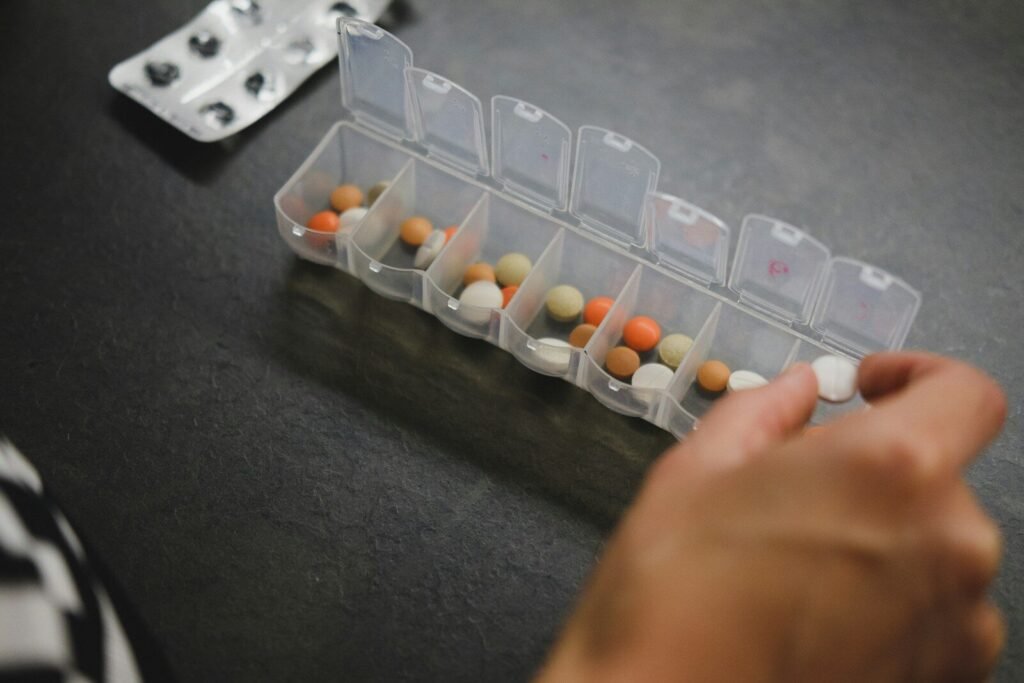
Go get your prescription bottles. All of them. This takes five minutes and it sometimes solves the whole thing.
Several very common medications lower desire or cause dryness. Antidepressants are the big one, especially SSRIs, and this side effect is so common that it often goes unmentioned because everyone assumes you already know. The 2025 urology guideline also lists birth control pills, spironolactone, antihistamines, and anti-androgen medications among drugs that can dry out vaginal tissue.
Thyroid problems belong on this list too. They overlap with perimenopause symptoms almost perfectly, and they are easy to test for. One sexual medicine specialist pointed out that low thyroid function has loss of sexual desire as a major side effect, which is exactly why a full workup matters before you assume the answer is hormones.
Bring the bottles. Ask directly whether any of them could be part of this.
Why Waiting to Feel Like It Almost Never Works
Ask yourself what you are actually waiting for.
Most of us were taught one model of desire. It arrives on its own, out of nowhere, and then you act on it. No spark, no sex. That model came from studying men, and it fits a lot of men reasonably well.
It never fit most women.
A researcher named Rosemary Basson proposed something different. In her model, desire often follows arousal rather than coming before it. You start from neutral. You are open to it, not craving it. Then touch happens, arousal builds, and desire shows up second. This is called responsive desire, and for many women in long relationships it is the normal pattern, not a broken one.
Read that again if you need to. You may never have had much spontaneous desire in the first place. Perimenopause just took away whatever was left, and now the absence is loud.
If that is true for you, then waiting to feel like it is the wrong plan. Nothing will arrive. What works better is being willing to start and letting your body catch up.
One thing needs saying clearly here. Willingness is yours to offer. It is not something you owe anyone, and this idea is not a reason for a partner to push. If sex hurts, willingness is not the answer. Treatment is.
Which brings us to what actually works.

6 Treatments You Can Ask Your Doctor For Right Now
The treatment landscape changed in the last year. If you read an article about this in 2022, some of it is now out of date.
Vaginal estrogen for dryness and pain
This is the most strongly supported option in the 2025 guideline from the American Urological Association, which was also endorsed by The Menopause Society. It comes as a cream, a tablet, an insert, or a soft ring you leave in for three months. Very little of it gets into your bloodstream, which is why it is treated differently from whole-body hormone therapy.
Vaginal DHEA and ospemifene
The same guideline recommends vaginal DHEA as an option for dryness and painful sex, and lists ospemifene, a daily pill, as another choice. These are useful if you want or need something other than estrogen.
Moisturizers and lubricants
These are recommended too, either on their own or alongside other treatments. They are different things. A lubricant is for the moment. A moisturizer is used a few times a week whether or not you are having sex, and it works on the tissue over time. Most women only use the first one and wonder why it is not enough.
Whole-body hormone therapy
In 2026, the FDA approved label changes to six menopause hormone therapy products, removing risk statements about heart disease, breast cancer, and probable dementia from the boxed warning. That warning had frightened a lot of appropriate candidates away for two decades.
Be careful with how you read that news, though. The Menopause Society agreed with dropping the warning on low dose vaginal estrogen, but noted that whole-body estrogen still carries real risks for some women, with the lowest risk for younger, healthy women starting closer to the transition. It is a real option worth discussing. It is not a green light for everyone.
A pill specifically for low desire
In 2025, the FDA approved Addyi, the brand name for flibanserin, for low sexual desire in women under 65. Before that, it was only cleared for women who had not yet reached menopause, which left a large group with nothing.
Be realistic about what it does. The trial behind the approval included 447 postmenopausal women, and the medication improved satisfying sexual events by 0.9 per month compared to 0.6 on placebo, with a small gain on a desire score. That is a real effect. It is also a modest one, and it is a daily pill with sedation as a side effect.
Testosterone, used carefully
An international group of ten medical societies reviewed the evidence and concluded that testosterone can improve sexual wellbeing in postmenopausal women with low desire that causes them distress, with gains in desire, arousal, orgasm, and pleasure, and less worry about sex. The average benefit works out to roughly one additional satisfying sexual encounter per month.
Two things to know. There is no FDA approved testosterone product made for women in the United States, so any prescription is off label. And low desire that genuinely bothers you is the only use the evidence supports. It is not a treatment for tiredness, mood, or brain fog.
If you are not sure where to start, most doctors would fix the physical symptom first. Solve the pain, then see what is left.
3 Popular Treatments the Research Does Not Support
Nobody writes this section, which is exactly why you should read it.
Vaginal laser and radiofrequency
These are marketed heavily and cost thousands of dollars. The 2025 urology guideline states plainly that the evidence does not support carbon dioxide laser, Er:YAG laser, or radiofrequency for dryness, irritation, painful urination, quality of life, or painful sex. The panel called these treatments experimental outside of clinical trials.
Herbal supplements for libido
The same guideline concluded that the evidence does not support alternative supplements for these symptoms. That covers most of what you will find marketed to women our age.
Compounded hormone pellets
The Menopause Society has raised safety concerns about compounded hormone products, including pellets, because they are not regulated and the actual dose in them is not verified.
Before you pay for anything, ask one question. What clinical guideline recommends this, and can you show it to me? A good provider will not mind being asked.

What to Start This Week Without a Prescription
Self-help advice on this topic usually sounds like a brush-off. So look at the numbers first.
In a 2025 trial, researchers tested two online programs for women with low desire and arousal. One used mindfulness, the other used cognitive behavioral therapy. Both produced large improvements in desire and arousal and lowered sexual distress compared to a waitlist group, and the gains generally held at follow-up. These were not small effects. They were among the largest in this whole article.
Regular sexual contact seems to help the tissue too. A 2025 study published in Menopause found that women in their 40s through 70s who had been sexually active in the past three months had lower odds of vulvar pain, dryness, and irritation, and their orgasm and satisfaction scores did not drop with age. Desire, arousal, and lubrication scores did fall with age. Orgasm and satisfaction held steady.
One honest caveat. That study shows a link, not proof that one caused the other. The women having more sex may simply have had less pain to begin with.
Here is a structure you can actually follow this week.
Pick one physical symptom and treat it. Not all of them. The one that bothers you most.
Schedule one session of touch with no goal attached. No expectation of sex, no scoreboard. This is how responsive desire gets a chance to work.
Have one ten minute conversation with your partner where you explain what changed and what you are doing about it. Not an apology. An update.
Protect your sleep like it is a medication, because in this case it functions like one.
How to Bring This Up So Your Doctor Actually Listens
Most women never raise it, and most doctors never ask. That silence is the single biggest reason this goes untreated.
Mayo Clinic surveyed nearly 5,000 women aged 45 to 60. Thirty-four percent reported moderate to very severe symptoms, with sleep and sexual problems often rated among the worst. And roughly 87 percent never sought medical care for them. The top reasons were being too busy and not knowing effective treatments existed.
The gap is enormous. The FDA noted that in 2020, about 41 million American women were between 45 and 64, while only about 2 million received a hormone therapy prescription.
So be specific. Vague gets dismissed.
Do not say you have been feeling off lately. Say this instead. Sex has become painful and I want to talk about treatment for genitourinary syndrome of menopause. Naming the condition changes the entire conversation, because now your doctor knows you have done your homework.
Bring your sleep log. Bring your medication bottles. Say the one thing you most want fixed.
If you get brushed off, that is information about your provider, not about your problem. The Menopause Society keeps a searchable directory of certified practitioners at menopause.org. The International Society for the Study of Women’s Sexual Health lists sexual medicine specialists at isswsh.org. If the emotional side is a big piece of this, AASECT certifies sex therapists and lists them at aasect.org. And if you have pelvic pain or tightness, the 2025 guideline supports referral to a physical therapist who specializes in pelvic floor conditions.
Pick One Thing and Start There
Your desire shifted for reasons that are real and measurable. Fluctuating hormones. Tissue changes that do not heal on their own. Two years of broken sleep. A medication nobody flagged. And a model of desire that was probably never accurate for you in the first place.
Almost every one of those has a treatment.
You do not have to fix all of it. Pick the single symptom that bothers you most, and book an appointment for that one thing. Say the specific words. Bring the notes.
Changes to your perimenopause libido are common, but common does not mean you have to live with them. Most women in your position never find out there were options. You just did.
This article is general information, not medical advice. Talk with your own doctor before starting or stopping any treatment.